With an opening presentation by Michelle Brouhard, Head of Policy and Geopolitical Risk at Kpler — the leading data and analytics platform for international trade and the world's foremost provider of vessel tracking and maritime intelligence — the Fundación Chilena del Pacífico held its second board meeting of 2026.
Brouhard's analysis addressed the outlook for global energy markets, geopolitical pressures on strategic maritime corridors of enormous significance for the international trade of fuels and raw materials, and the specific risks these scenarios pose for Chile. Her presentation provided highly valuable insights for the subsequent dialogue among board members, including representatives of the country's leading companies and government officials responsible for international economic relations, export promotion, and the Asia-Pacific Division of the Ministry of Foreign Affairs.
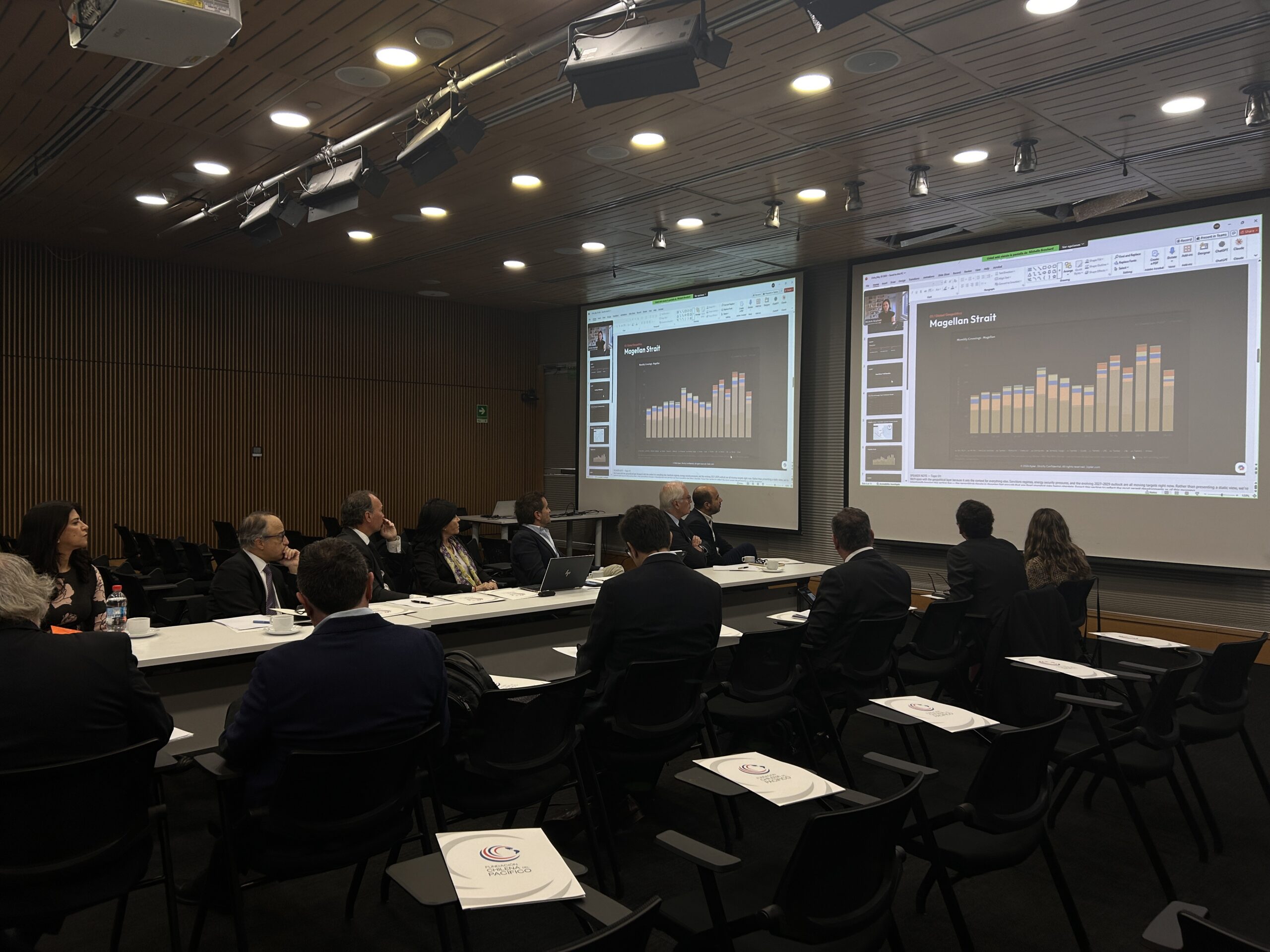
Brouhard presented an analysis of what she termed "global maritime toll booths," highlighting that the world's five busiest straits — led by Malacca-Singapore, with an estimated annual passage value of US$72 billion, followed by Gibraltar, Taiwan, Hormuz, and Dover — concentrate commercial flows of enormous magnitude. A Kpler analysis indicates that the eventual installation of tolls at the ten most strategically relevant straits in the world could generate up to US$136 billion in annual revenues. In this context, she noted that Iran and Oman are already discussing charging a toll on the Strait of Hormuz — equivalent to US$2 per barrel of oil transiting it — and that the Strait of Magellan, under Chilean sovereignty, represents a route with still-underestimated revenue-generating potential, whose monthly traffic has shown sustained growth throughout 2025 and into early 2026.
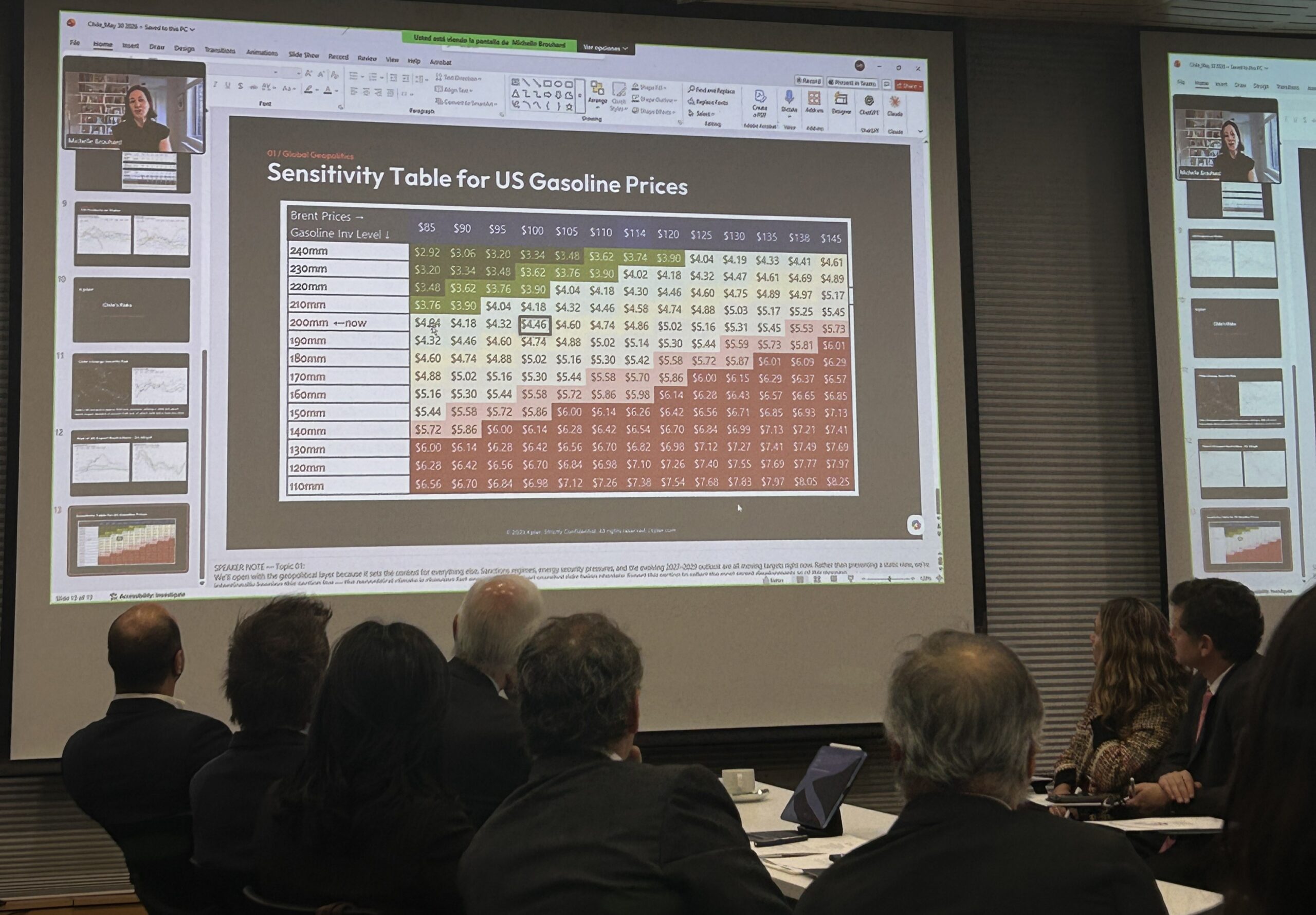
On the subject of energy security, the speaker warned about the strategic petroleum reserve (SPR) replenishment process underway among the leading member countries of the International Energy Agency. In the case of the United States, the government will need to refill 207 million barrels beginning in the fourth quarter of 2026, raising the risk that Washington could impose restrictions on derivatives exports should domestic gasoline prices reach or exceed US$5 per gallon — a politically sensitive threshold that, according to Kpler's sensitivity models, could be reached with Brent crude around US$100 and inventory levels below current figures.
This situation is of particular relevance for Chile. The country consumes approximately 400,000 barrels per day, of which domestic refining covers around 280,000, leaving an import gap of roughly 150,000 barrels per day. Of that imported volume, approximately 130,000 barrels per day originate from the U.S. Gulf Coast, transiting through the Yucatán Strait. A U.S. export restriction or a disruption along that route would leave Chile significantly exposed, with few immediate supply alternatives.
Our special thanks to Banco Bci, a partner company of the Foundation, for hosting this meeting at their facilities.
This event has no additional material